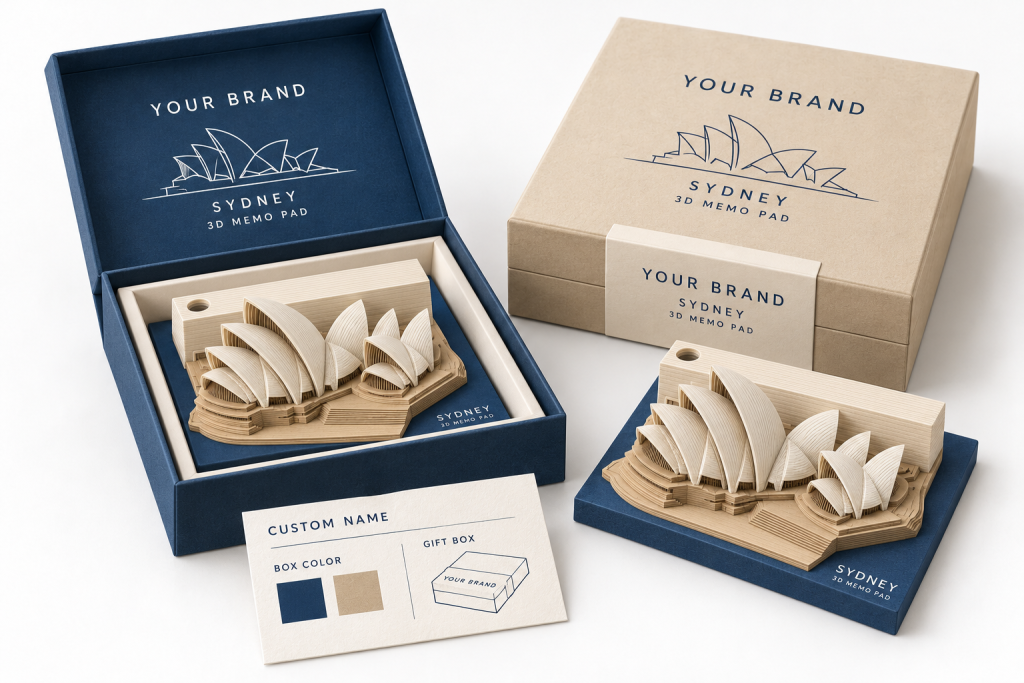
Look at the history of the original Omoshiroi Blocks and one thing stands out: the very first designs weren’t castles or animated scenes — they were landmarks. Kiyomizu-dera temple, Tokyo Tower, city skylines. Because while a character scene appeals to fans, a landmark appeals to everyone who has ever stood in front of it, photographed it, or calls that city home.
If you run a museum shop, a tourism store, a city-brand label, or a hotel gift corner, a landmark 3D memo pad is arguably the single most defensible product you can put on the shelf. Here is the complete customization process, from the photo you send us to the cartons you sell.
Why landmark designs sell so well
- Emotional anchor. Visitors buy a piece of the place they just fell in love with — the pad is a memory they can hold.
- Defined audience, defined season. Tourism flows are predictable: exhibition runs, peak travel months, graduation trips. You can order against demand.
- Photographs itself. The tear-away reveal in front of the actual landmark is a promotional video shot for free.
- Higher perceived value than typical souvenirs. A mass-produced magnet sells for pocket change; a layered landmark sculpture supports gift pricing.
What you need to prepare
Not much — genuinely. To design a landmark pad, we need:
- Reference photos of the landmark. A handful of clear shots from the angle your market recognizes it by — the postcard view, essentially.
- Any brand assets, if you want your logo engraved on the base or printed on the box.
- Your format preference: memo pad (used daily, tear-away reveal) or desk calendar (a year of pages), with or without an LED base.
- Your quantity. Any number — our MOQ is a single piece, so a pilot batch is a perfectly normal starting point.
The custom process, step by step
- Send your references by email. A designer replies within hours — 24/7, no form-filling marathon.
- Free 3D design proof within 48 hours. Our team converts the landmark into a layered paper structure and sends a rendering: how many layers, which colors, how the scene reads at each tearing stage.
- Revise until it’s right. Revisions are free. This is the stage where we get the silhouette perfect.
- Physical sample in 5–7 days. Laser-cut and hand-assembled, shipped with the proposed retail packaging so you unbox exactly what your customer will.
- Mass production, 15–25 days. From one piece to hundreds of thousands — same line, same QC (AQL 2.5, three-stage inspection).
- Retail-ready delivery. Gift box, acrylic dust cover, barcodes, inserts — and Amazon FBA labeling or museum-store-ready cartons if you need them.
What makes a landmark scene sell (and what kills one)
After designing dozens of landmark pieces, these are the decisions that matter most:
- Pick the iconic angle, not the accurate one. People recognize the postcard view, even if it’s not the most interesting facade. Start there.
- Silhouette first. A landmark must be recognizable as a solid black shape before color or detail is added. If it fails the silhouette test, no amount of layering saves it.
- Restrain the palette. Two to four paper colors read as “crafted.” Ten colors read as “cheap print.” The best landmark scenes are disciplined.
- Use the tear-away pacing. For memo pads, the landmark should emerge gradually — first the base and landscape, then the structure, the spire last. The reveal is the product.
- Choose the base deliberately. An LED base turns the same artwork into a night-lit keepsake (and a higher price point); a plain base keeps the price accessible for volume souvenir sales.
- Design the box like a postcard. Tourism buyers photograph packaging. A gift box that echoes the landmark extends the value of the piece.
A quick word on rights
Landmarks sit in a gray zone: traditional architecture (temples, historic buildings) is generally safe to reproduce, while some modern buildings and illuminated structures carry design or trademark protections in certain jurisdictions. The rule we follow: we craft themes from the artwork and references you provide, and obtaining any required authorization for commercial resale is the brand owner’s responsibility. If you want a completely worry-free line, ask us about stylized interpretations — the skyline inspired by the city rather than a precise replica.
Cost and MOQ: the short version
Because we’re the factory — not a trading company — you get direct pricing, and the order starts at one piece. Order a single landmark pad to test with your audience, put it on a shelf for a week, then scale what works. The design proof is free either way, so the real investment at the start is one email describing your landmark.
Have a landmark in mind — a temple, a tower, a bridge, a skyline? See how our custom 3D memo pad service works, or simply email info@aperlaser.com with the name of the place and a photo. We’ll come back within 48 hours with a design proposal, and you can judge it with your own eyes.