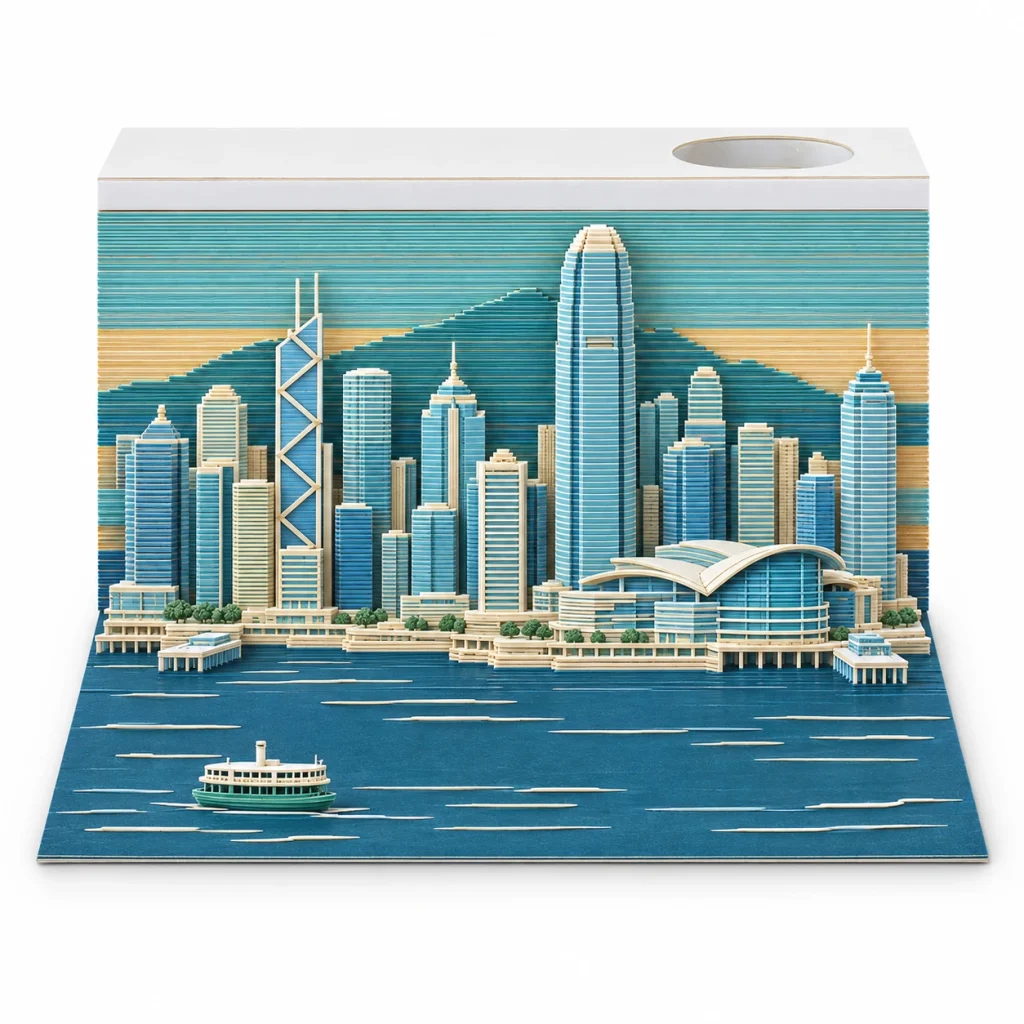
Every city has a wall of souvenirs: magnets, keychains, snow globes, printed mugs. Travellers buy them because it’s tradition — and then most of them end up in a drawer within a week. But a small number of keepsakes survive that journey intact, and it’s worth asking why.
If you’re a souvenir retailer, museum shop or destination brand, this question is your business. Here’s how we think about turning a city landmark into a souvenir people actually keep — and the practical route from a photo of a building to a product on your shelf.
Three reasons a souvenir survives the trip home
Recognition. The moment the buyer looks at it, they’re back on that bridge, at that viewpoint, in that square. A generic “I ♥ [City]” mug tells them where they went; a landmark silhouette reminds them how it felt. Recognition is what turns an object into a memory.
Presence. A keepsake earns its place because it lives somewhere visible — a desk, a shelf, a windowsill. Anything that goes into a drawer is gone, no matter how meaningful the trip was. This is the single biggest argument against flat, storable souvenirs.
Craft. People can feel the difference between a mass-printed item and one that took assembly. That difference is exactly what justifies a gift-shop price instead of an airport-souvenir price — and what makes the piece worth showing to a friend back home.
Why the landmark matters more than the format
Some landmarks convert into souvenirs almost automatically, and it’s rarely about fame. The pieces that work share three traits: a clear silhouette, an emotional context, and an angle everyone photographs.
- A clear silhouette. If the landmark doesn’t read as a solid black shape, it will struggle at small scale, whatever the medium.
- An emotional context. The building itself is only half the story — the bridge, the harbour, the trees around it are why people remember being there. Context makes the scene.
- A signature viewpoint. Every landmark has an angle that visitors gravitate to. That’s the view to build from, not the most “accurate” one.
Notice something about that list: none of it depends on the landmark being world-famous. A town clock tower with a strong silhouette and a beloved viewpoint can outsell a globally recognised building that flattens into a shapeless blob on a shelf. Local recognition beats global fame.
From photograph to layered paper sculpture
One format that answers all three “survival” criteria is the layered paper keepsake — the 3D memo pad and its cousin, the papercut light box. The scene lives in the depth of the material: dozens of paper layers stacked so the landmark appears gradually as the pad is used, and remains as a small sculpture when the sheets are gone.
Turning a landmark into one is a design process, not a printing process. Here’s how it typically runs:
- Choose the angle. We work from the view travellers photograph most, confirming the landmark reads instantly as a silhouette.
- Build the layers. The scene is broken down into depth planes — foreground street or water, the building itself, sky, details — each assigned a paper colour.
- Design the reveal. For memo pads, the sequence matters as much as the final image: what appears first, what stays hidden until the last third of the pad.
- Test at real scale. Fine architectural detail doesn’t always survive at 8 centimetres. Some simplification is almost always part of the process — the goal is recognition, not blueprint accuracy.
- Sample, review, produce. A physical sample of the actual product before any bulk commitment, then production at the agreed quantity.
One practical note for anyone planning this: a photograph does not automatically become a good design. Contrast, angle and how much detail competes for space all matter. A feasibility review — free, before you commit to tooling — is what tells you whether your landmark will work as a paper sculpture.
One landmark or a city series?
Both are valid, and the choice shapes your whole product line.
A single landmark piece is a hero product: one design, deep focus, ideal for a specific attraction or a museum’s signature building. A city series — skyline, waterfront, old town, modern district — turns the shelf into a collection and gives returning visitors a reason to buy the next piece. Many shops find a series outperforms a single design, because the whole range reads as a category instead of a novelty.
For the design and packaging details, the quantities a series involves, and how branding and private-label presentation fit in, our custom city souvenir 3D memo pad service page covers the full process, or you can see the complete 3D memo pad line.
A last word on rights
Landmarks sit in a gray zone. Historic architecture, temples and public buildings are generally safe to reproduce; some modern structures and illuminated works carry design or trademark protections in certain jurisdictions. We craft scenes from the references our clients provide, and confirming you’re cleared for commercial resale of a specific landmark is the buyer’s responsibility. If you’d rather avoid the question entirely, a stylized interpretation of a skyline — inspired by the city rather than a precise replica — is often both safer and more distinctive.
What to do next
If you have a landmark in mind, the first step costs nothing: email us the name of the place and a few photos. You’ll get a free design review — including an honest answer about whether it works as a layered paper scene — usually within 48 hours. Send it to info@aperlaser.com.